15 Jul 2026 From Dashboards to Agentic Analytics: The Next Step in AI-Driven BI
For many years, dashboards have been the default interface between business users and enterprise data, helping organisations to standardise reporting, monitor performance, and make data more accessible across departments. However, dashboards have always had one limitation: they are designed for questions that have already been anticipated, and this becomes a problem when users need to investigate something new, respond to a sudden change, or support a decision with data that is not readily available. Many organisations have a large number of dashboards, yet the decision-makers sometimes struggle to access the data they need because their business questions are more dynamic than traditional reporting models can support.
Of course, dashboards aren’t obsolete, and remain essential for standard reporting, operational monitoring, and other business processes. But the way users interact with data is changing. They increasingly expect to ask questions in natural language, receive clear answers based on enterprise data, and explore follow-up questions without delays. This is conversational BI: the ability to “talk to your data”. Instead of navigating through several dashboards, applying filters manually, or requesting support from an analyst, users can ask real questions such as “What were our highest-performing regions last quarter?” or “Why has attrition increased in this department?”
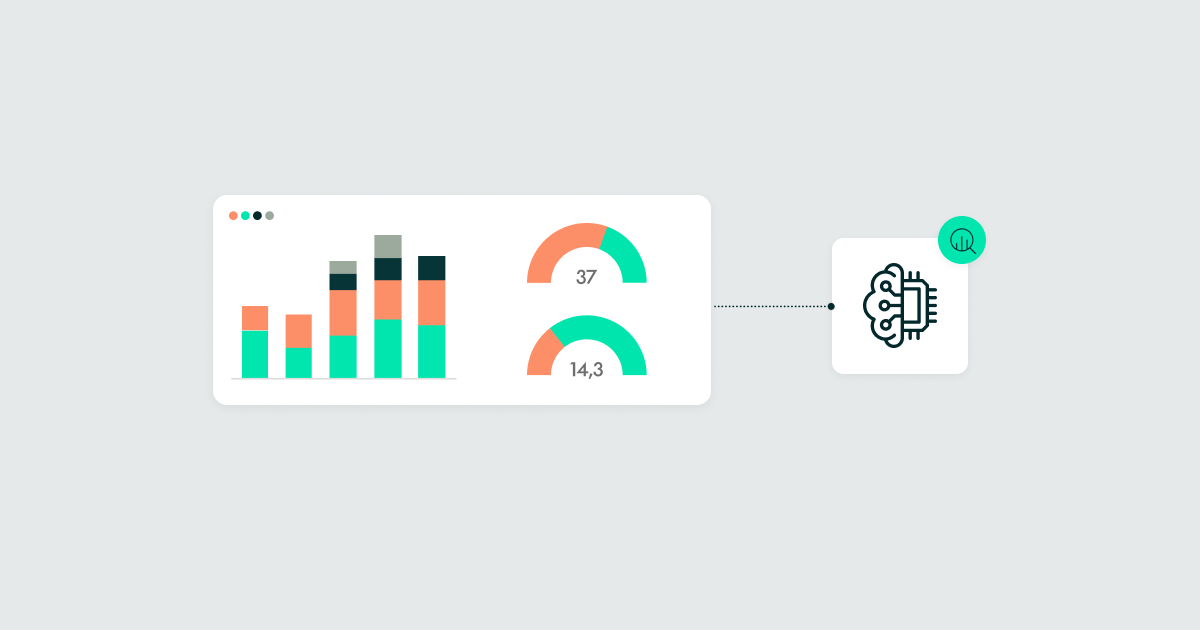
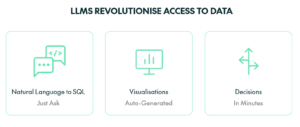
A simple demo can show why this is attractive. Imagine asking for the average hotel price per night in a specific district of Madrid: the model connects to the relevant database, generates a SQL query, executes it, and returns the answer. The user then asks for the most expensive neighbourhoods in Madrid, and the system produces both a result and a visual comparison. In this type of scenario, LLMs generate SQL, interpret data, produce explanations, and create visualisations, helping users move from question to result in minutes.
However, simple demos can create a misleading impression: they usually work because the data scope is limited, the schema is clear, and the question is relatively simple. Enterprise environments are different, involving thousands of tables, inconsistent naming conventions, complex business rules, sensitive data, overlapping systems, and multiple user roles. This is where the real challenge begins.
The Problem with Enterprise Data
As we discussed in a recent blog post, the hard part of AI-driven BI is not the chat interface, but the data foundation beneath it. AI success depends on infrastructure that can provide reliable, governed, accessible, and meaningful data.
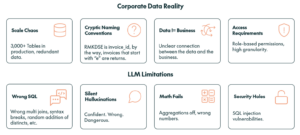
Imagine a customer with more than 3,000 production tables, redundant data, similar table names, unintuitive field names, and hidden business logic. It’s a situation we see all too often, and it’s exactly what makes enterprise analytics so challenging. An analyst can learn this context through experience, documentation, conversations with business users, or trial and error, but an LLM can’t. Without the right context, the model may produce an answer that looks convincing but is wrong.
This is why data catalogues, semantic models, documentation, ontologies, business glossaries, and dedicated AI-ready data layers are becoming central to AI-driven BI. LLMs need clear metadata and business context, from table meanings and field interpretation rules to valid joins, applicable business logic, and trusted definitions. In traditional BI, a weak data foundation limits reporting quality. In AI-driven BI, it creates a greater risk, as users may not see the assumptions, joins, filters, or business logic behind an AI-generated answer. AI should extend the governance framework, not bypass it.
The Limitations of LLM-Based Analytics
LLMs are powerful, but they’re not magic. In analytics, their limitations matter because business users don’t want creative text, but answers that can inform real-life decisions.
SQL generation is one clear limitation. LLMs may handle simple queries well, but multi-table joins, ambiguous fields, and hidden business logic can easily produce technically valid SQL that misses the real business question.
Hallucinations still present a risk, even more so in agentic systems, where each additional step, tool call, or reasoning node can become another potential point of failure. A workflow that retrieves metadata, generates SQL, interprets results, creates visualisations, and proposes actions needs stronger controls than a single chatbot response.
Another limitation is calculation. LLMs can explain mathematical logic fluently, but they’re not reliable calculation engines. Actual calculations should be performed by the database, the BI engine, or a dedicated analytical service. The model can help orchestrate the process and explain the result, but it shouldn’t do the maths.
Security is another major concern: prompt injection, inappropriate data exposure, and uncontrolled tool execution are real dangers. Role-based access must be applied to the AI layer, ideally coming from existing authentication and authorisation systems. Users should not be able to access sensitive financial, HR, or customer data simply because they can phrase a question cleverly.
Production AI analytics still needs guardrails: input and output validation, governed semantic layers, query inspection, feedback loops, monitoring, and clear escalation mechanisms when the system can’t answer reliably.
What Makes Analytics “Agentic”?
Conversational BI and agentic analytics are closely related, but not the same: agentic analytics goes further, and is able to interpret intent, decide which data source or tool to use, route a question to a specialised agent, apply business context, execute a multi-step process, and return an answer that is not merely retrieved but assembled through a controlled workflow. In other words, the system starts to behave less like a search box and more like an assistant, moving from reactive to proactive.
This distinction is increasingly visible in the market. For example, the Databricks 2026 Genie announcements extend conversational analytics into a broader agentic model through Genie One, Genie Agents and Genie Ontology, combining governed business context with reusable agents designed to automate work.
Snowflake is following the same path from conversational analytics towards agentic orchestration: Cortex Analyst provides a fully managed, LLM-powered natural-language interface for answering business questions over structured Snowflake data, whilst Snowflake Cortex Agents extend this into a broader agentic platform where agents can reason over requests, plan work, call tools, execute code, and generate responses within the Snowflake environment.
For organisations, the key point is that agentic analytics is not just “chat with your dashboard”, but a new analytical layer that connects each question to the appropriate data, logic, permissions, and workflow. This also means that it must be designed properly: a general-purpose assistant may be great for general tasks, but enterprise analytics requires domain-specific understanding. Finance, procurement, HR, sales, operations, and supply chain all have their own definitions, systems, permissions, and business rules, and a single generic agent can’t handle all that safely or accurately.
Market signals suggest that the shift towards agentic AI is accelerating, but maturity remains uneven. This reflects what we’re already seeing at ClearPeaks in customer conversations and implementations: interest has moved beyond isolated chatbots towards governed, domain-specific agents embedded in analytical and operational workflows. The next step is turning that interest into production-ready solutions built on a strong data foundation.
Gartner’s 2026 Hype Cycle for Agentic AI reports that only 17% of organisations have deployed AI agents to date, whilst more than 60% expect to do so within the next two years.
However, this momentum is running ahead of organisational readiness: Deloitte’s 2026 State of AI in the Enterprise report found that 74% of respondents expect their companies to be using AI agents at least moderately by 2027, but only 21% say their organisations already have an effective governance model for agentic AI.
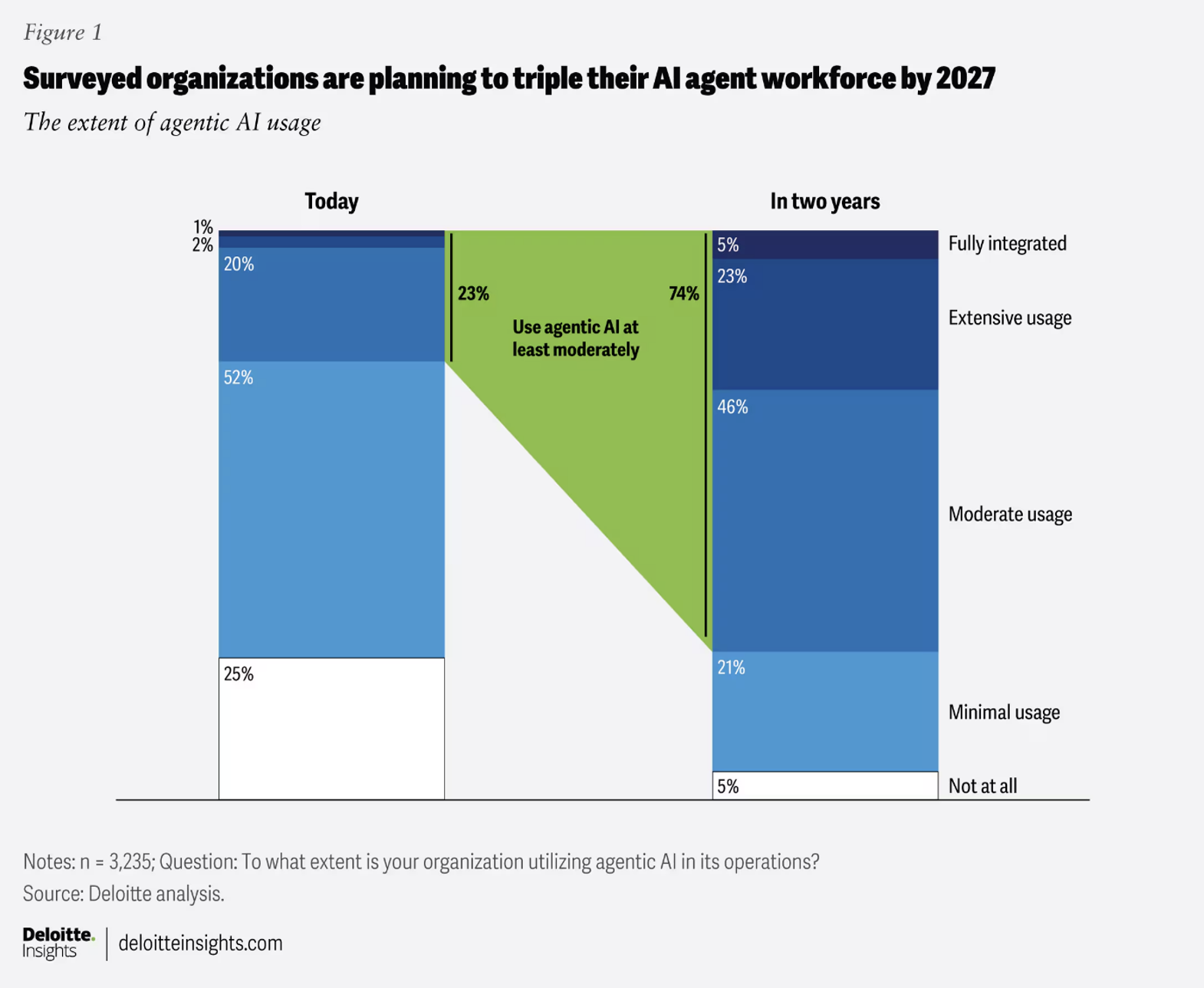
These industry surveys reinforce the core message: moving from conversational BI to agentic analytics is not just an interface challenge; it requires trusted data, governance, validation, and operating discipline.
Agentic Analytics in Practice
The shift from conversational BI to agentic analytics is already appearing in some of our projects. In one case, an energy company customer needed a single AI entry point across multiple business domains and divisions. Our solution uses a router agent to redirect questions to the right domain-specific sub-agents, which then provide specialised answers that are returned to the user. This is a genuinely agentic pattern: rather than expecting one assistant to understand every domain, the architecture separates responsibilities. The router interprets the question and directs it to the appropriate specialised agent, so each sub-agent can work with its own domain context, data sources, business logic, and response patterns.
In another case, the HR department of a government customer wanted to enhance operations with more than a chatbot: a platform with its own user interface and AI engine to assist with tasks such as generating job descriptions and helping employees prepare their objectives for the year ahead. This shows that agentic analytics is not limited to just answering questions, but able to run structured business workflows where data, policy, documentation, and organisational rules need to be combined.
Another example is a mobility services customer that wanted to democratise data and BI across the organisation. The goal was ambitious: to give users across different business areas a greater degree of self-sufficiency when exploring their own data and generating the insights they need. In practice, this means reducing dependency on central BI teams for every analytical request, whilst ensuring that users work with governed data, trusted definitions, and the appropriate business context.
Together, these cases show the direction we’re moving in: from faster access to answers towards broader, more contextual and more operational agentic workflows.
Our View: Context, Scope, and Control
Here at ClearPeaks, this distinction between general AI assistance and domain-specific agents is a recurrent theme in our recent work. In our Copilot Studio post we explain how agents can tackle domain-specific challenges, automate workflows, and interact with organisational data.
The same principle appears in our post about Databricks agentic ingestion, where we describe an AI agent built on top of an existing ingestion framework, enabling business teams to trigger ingestion processes and ask metadata-related questions, whilst maintaining efficiency and reliability.
The common thread is clear: agentic systems should augment governed enterprise processes, not bypass them.
Building Agentic Analytics for Production
To deploy agentic analytics successfully, organisations need more than a model and a chat interface. The first requirement is a governed data foundation: discoverable, documented, and trusted data aligned with clear business definitions, as we explained in a recent article.
Secondly, agents should have defined responsibilities. A finance agent, for example, should not be able to answer HR questions; a procurement agent should understand supplier terminology, contract logic, purchasing workflows, and the relevant permissions. A clear scope makes the agent useful and governable.
Security and validation must also be built in from the start. Existing access rules should carry through to the AI layer, so users cannot retrieve datasets, metrics or documents they would not normally be allowed to access. At the same time, organisations need mechanisms to check generated SQL, inspect intermediate steps, capture feedback, monitor answer quality, and refuse to answer when the available context is insufficient.
Human oversight is essential. Agentic analytics can support decision-making, but it shouldn’t make important decisions. The role of the system is to accelerate exploration, structure analysis, surface options, and support action, whilst real responsibility remains with people.
Finally, organisations need an adoption plan: users must understand when to trust the system, when to challenge it, and when to escalate to a human expert.
Conclusion: The Next Layer of BI
AI-driven BI is moving fast. The first wave focused on conversational experiences; the next wave is agentic. Dashboards, semantic models, governed datasets, reports and analytical applications will remain essential because agentic analytics depends on the same foundations as successful BI: trusted data, clear definitions, secure access, reliable pipelines and strong governance.
The proof-of-concept phase is giving way to production. The question is no longer whether AI can query data; it can. The real question is whether organisations can make AI-driven analytics reliable, contextual, secure, auditable, and genuinely useful for the people making decisions.
If you would like to explore how agentic analytics could support your organisation, get in touch with our dedicated team!