12 Ago 2026 AI-Assisted Development: How Coding Agents Are Reshaping Skills, Teams & Enterprise Software
Software development is entering a new phase: the first generation of AI coding tools mainly completed individual lines or suggested short functions, whereas the latest coding agents, such as Claude Code, can work across an entire codebase and carry out multi-step development tasks. This shift matters because it changes more than just the speed at which code is written. It also affects how development work is organised, which skills become most valuable, how junior developers learn, and whether organisations can now build their own software.
Here at ClearPeaks, we are already seeing this change in customer conversations and project work. In popular technology stacks such as Python and JavaScript, AI coding assistants can now generate useful code with clear practical value; in languages such as C and C++, performance can be less consistent. The challenge now is to identify where the real productivity gains lie and who is best placed to capture them. Organisations must also determine how to introduce these tools without weakening security, quality, or long-term technical ownership, while continuing to give junior developers the training and supervision they need to build genuine skills.
From Code Completion to Agentic Development
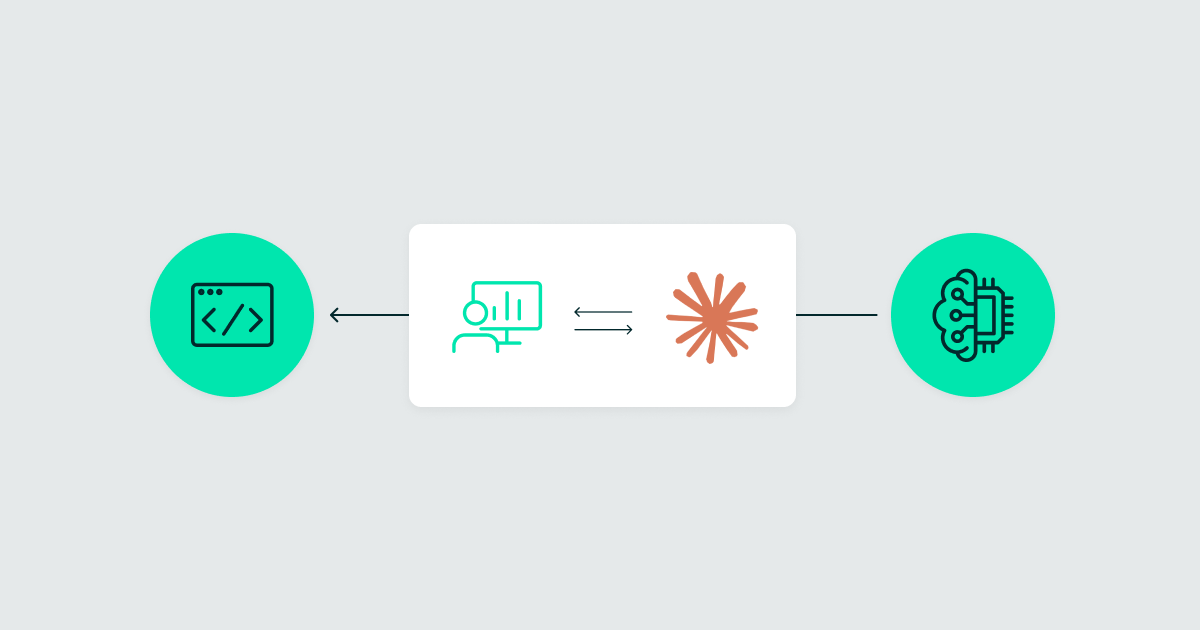
Agentic development goes much further than the first AI-assisted coding tools: a coding agent can plan a sequence of actions, search a repository, edit several components, run commands and tests, inspect the results, and continue iterating before returning the work for review. This has created a new division of labour: the developer defines what the system has to do, provides the necessary context and constraints, and determines what constitutes an acceptable result, whereas the coding agent handles much of the file-level execution.
Anthropic’s June 2026 analysis of around 400,000 Claude Code sessions between October 2025 and April 2026 shows how this division of labour is emerging in practice. In a typical session, users made around 70% of the planning decisions (what to do), whilst Claude made approximately 80% of the execution decisions (how to do it). The same research found that users with greater task-specific domain expertise achieved higher success rates and recovered more effectively from errors, suggesting that understanding the problem remains more important than simply generating code quickly.
This doesn’t make software development fully automatic: a coding agent can implement a well-defined connector, generate repetitive data-access logic, or investigate the cause of a test failure, but responsibility for the business objective, architectural trade-offs, security requirements, and long-term maintainability remains with the development team.
Neither should the impact of AI-assisted development be measured just by the amount of code a tool produces or how quickly it completes an isolated task. Productivity needs to be assessed across the full development lifecycle; an apparent gain during implementation may disappear if the generated output requires extensive review, correction, additional testing, or maintenance. For organisations, the real question is whether AI can help the development team to deliver reliable software more efficiently, rather than merely producing more code in less time.
Why Experience Matters More
This new generation of coding tools is sometimes presented as a way to reduce the need for technical expertise, but in practice, the opposite is often true: a senior developer contributes most when translating a business problem into a coherent system. However, before these modern agents, that same developer also had to spend considerable time on routine implementation work, repetitive connectors, unfamiliar technologies, and low-level debugging.
An effective coding agent can now take on some of that work; it can also act as a technical sparring partner, identifying a suitable library or connector, suggesting an alternative architecture, or investigating a problem in parallel. The developer is still responsible for deciding whether the proposed approach is appropriate, but can devote more time to architecture, integration, security, and the decisions where professional judgement can add extra value.
The developer’s role is shifting from creating every component manually towards directing, evaluating, and correcting AI-generated work. Experienced oversight remains essential: faster code generation can also produce unnecessary, inconsistent, or insecure code more quickly. The development team must still validate the implementation, ensure that it meets the business requirements, and take responsibility for the quality and maintainability of the finished solution.
Democratising Development Without Losing Control
The ability to generate code through natural language could also extend software development beyond established technical teams. Giving more people the means to turn their ideas into working applications is positive democratisation, but it comes with risks: someone without sufficient technical knowledge could accidentally expose an API key, create an insecure connection to a corporate system, or give an application access to restricted information. Organisations should therefore introduce these capabilities gradually rather than giving unlimited access to the entire workforce from the outset. An initial rollout might focus on employees with previous technical experience or on a defined group of suitable use cases, allowing the organisation to establish appropriate working practices before granting further access.
We are already seeing customers adopt a controlled model in which business teams are paired with digital teams: business users contribute their knowledge, requirements, and understanding of where the existing systems fall short, and the digital team operates the coding assistant, designs the solution, and is responsible for the result. Working together like this allows the organisation to benefit from closer collaboration without immediately distributing development credentials and deployment capabilities too widely.
As we have stressed in recent posts, existing data-access rules must also remain in place. Giving employees access to AI-assisted development should not allow them to bypass the controls that govern sensitive financial, operational, customer, or HR data.
When Software Becomes Cheaper to Build
The impact of coding agents extends beyond individual developers and development teams. If experienced engineers can achieve more in the same timeframe, the cost of producing a software solution can fall. This doesn’t mean that an organisation can replace a principal engineer with a group of graduates using coding agents: senior expertise remains essential for understanding the business problem, designing the architecture, guiding the implementation, and assessing the result. The economic advantage lies not in paying less for that expertise, but in increasing what a skilled developer or small team can achieve, making some previously unaffordable projects viable.
Making Digital Teams Viable for More Companies
Large enterprises have long been able to maintain dedicated digital teams, and we often work alongside them, helping to accelerate delivery and extend their capabilities. Smaller organisations, by contrast, have traditionally been more likely to commission individual projects or depend on standard software supplied by an external provider.
AI-assisted development could change this calculation. If a small number of experienced developers can produce more software, smaller companies may be able to justify creating their own digital teams. This could mean establishing an internal team of three or four developers, perhaps supported by a consulting partner, rather than commissioning a series of isolated projects. Problems that were previously too specialised or limited in scale to justify custom development could then be addressed through tailored solutions.
This remains an emerging possibility rather than a guaranteed outcome. Nevertheless, it could extend the benefits of dedicated software development beyond the large enterprises that have traditionally been able to afford it.
From General Products to Tailored Solutions
This increased development capacity could also make tailored software a realistic option in more cases. Commercial providers face an unavoidable trade-off: their products must remain broadly applicable to many customers, so they cannot always reflect the exact processes, terminology, assets, or business rules of an individual organisation.
This is particularly important in sectors with specialised operations. In oil and gas, for example, companies use software to support a wide range of upstream and downstream activities. An established product may provide the main capabilities required without fully matching the way a particular organisation works. A company may therefore begin to consider whether selected capabilities could be developed internally and adapted more closely to its operations. It already understands what the existing product does well, where it creates value, and where its limitations lie. A skilled internal team could use that knowledge to create a more focused solution for areas in which the standard product falls short.
We have already seen an example of this: one of our customers is investing in small development teams to build or reproduce selected software capabilities and customise them for its own use cases. The objective is not to copy a commercial product, but to address specialised requirements that a general provider cannot reasonably accommodate.
This doesn’t mean that every company should begin rebuilding its SaaS platforms. A mature commercial product includes far more than its visible interface: integrations, permissions, monitoring, support, documentation, updates, and years of accumulated expertise. General products will remain the right choice in many cases, but tailored development may become viable where the additional business value justifies the cost and the continuing responsibility for maintaining the software.
Conclusion
Our industry must ensure that the next generation of developers acquires the expertise on which it will depend. Junior developers need access to modern coding tools, but they also need experienced colleagues who can teach them how to question, review, and improve the output; without that support, organisations may obtain more code in the short term but lack real skills in the long term.
The most valuable result will not be the greatest possible quantity of AI-generated code, but software that solves the right business problem, reflects the organisation’s real requirements, and is managed by those qualified to take responsibility for it.
Here at ClearPeaks, we help organisations to connect their business requirements with the technical expertise needed to deliver reliable, specialised digital solutions. Get in touch with our team to explore how AI-assisted development could help you to accelerate software delivery and create greater value from your digital investment.